Vaast Colson — Episode 47a – B.S.
14.05.2026 — 17.05.2026
Vaast Colson
Episode 47a – B.S.
14 May—17 May 2026
Tweede locatie tijdens Antwerp Art Weekend: LLS Paleis – Aan ’t water
Vlaamsekaai 47, 2000 Antwerpen
Openingsuren: 14 mei 2026 van 12 – 21 uur, 15 tot 17 mei 2026 van 12 – 18 uur.
/
Second location during Antwerp Art Weekend: LLS Paleis – Aan ’t water
Vlaamsekaai 47, 2000 Antwerp
Opening hours: 14 May from 12 – 9 PM, 15 until 17 May 2026 from 12 – 6 PM.
Op vrijdag 29 mei om 20h organiseren we een gesprek tussen Vaast Colson en Adrien Tirtiaux. Eén van de uitgangspunten is de tegengestelde wijze van het gebruik van de tentoonstellingsruimte.
Locatie: Tirtiaux’s “Trojanisches Ding”, LLS Paleis, Paleisstraat 140, 2018 Antwerpen.
/
On Friday 29 May at 8 pm, we are organising a conversation between Vaast Colson and Adrien Tirtiaux. One of the topics of discussion is the contrasting ways in which the exhibition space is used.
Location: Tirtiaux’s “Trojanisches Ding”, LLS Paleis, Paleisstraat 140, 2018 Antwerpen.
NL
Chalkboard confessions, blackboard gags, stick-slips, kickflips and other writings
Episode 47a B.S.
Episode 47b J.B.
De enigmatische titel die is samengesteld uit woorden uit verschillende registers en jargons, toont de verbinding die Vaast Colson probeert te maken in zijn artistiek denken en werk: hoe verhoudt de kunstenaar zich tot de wereld en het leven? Waar ligt de klemtoon van het oeuvre in relatie tot gebeurtenissen in de wereld, welke verschillen in schaal en actie spelen hier een rol? Antwoorden hierop formuleren betekent telkens weer de uitdaging aangaan deze ijkpunten op te zoeken en het handelen hiernaar te richten (kalibreren).
Deze tentoonstelling vertelt over standpunten.
Een camera is gericht op de lucht, daalt vervolgens af naar de stad, haar straten en gebouwen, om uiteindelijk door een open raam in te zoomen op een klaslokaal.
De blik wordt gericht op het schoolbord.
De twee verschillende woorden in het Engels voor schoolbord wijzen op een verschil in pers-pectief: ‘Chalkboard’ verwijst naar het gebruikte materiaal (chalk) dat op het bord aangebracht wordt, ‘blackboard’ definieert een eigenschap (black) van de drager. Beide betekenaars, die verwijzen naar hetzelfde maar we anders benoemen, inspireren Colson, die zich interesseert voor dit soort van verschuivingen.
Die “verschuiving” is vaak irritant. Colson benoemt ze in het volgende woord uit de titel: Stick-slips. Dit is het verschijnsel waarbij soms spontaan een schokkende beweging optreedt bij het over elkaar schuiven van twee voorwerpen. Deze schokkende beweging gaat vaak gepaard met krakende of schurende geluiden (lage frequenties) of gejank (hogere frequenties). Een bekend voorbeeld hiervan is het piepend krijtje op het schoolbord.
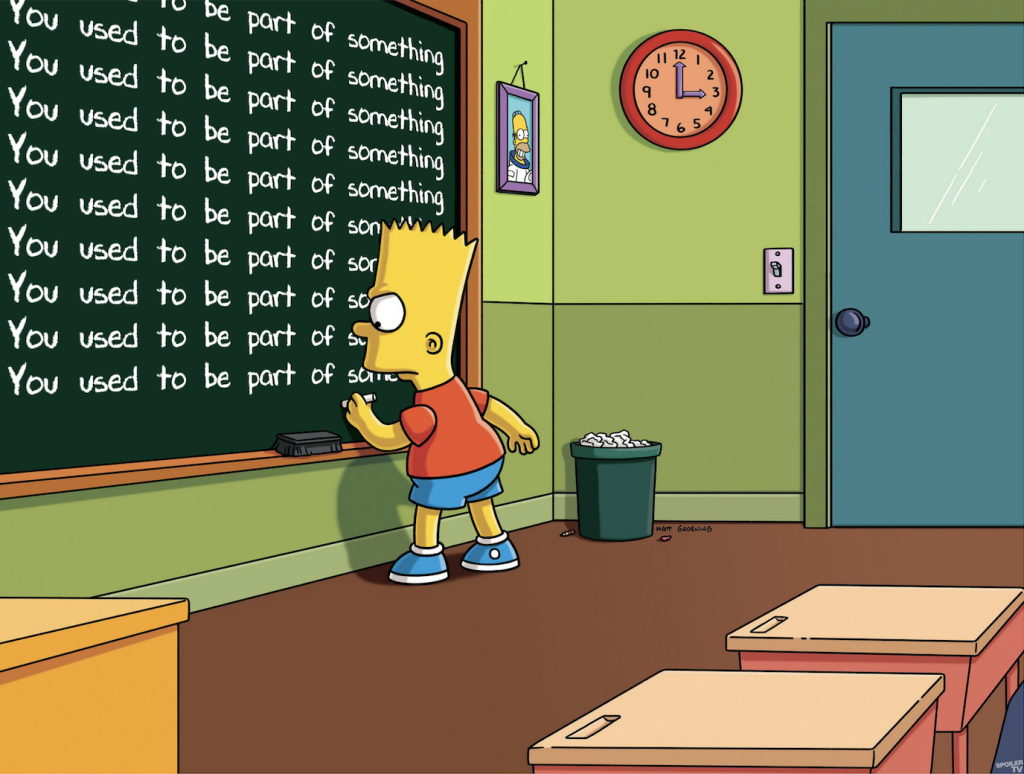
De kickflip is een truuk bij het skateboarden: de rijder springt met zijn board in de lucht en schuift zijn voet naar buiten, waardoor het skateboard 360 graden rond zijn as draait. Daarna is het de bedoeling dat de rijder terug op het skateboard landt. Onderaan staat de afkorting B.S.: Bart Simpson. Het franke jongetje uit de serie van Matt Groening start bij iedere openingssequentie van The Simpsons met een zin die hij telkens op een nieuwe regel op het schoolbord schrijft (als straf?) tot de bel gaat.
Een week later toont Vaast Colson het tweede deel van het werk, nu gesigneerd met J.B.
In 1972 werd Joseph Beuys (1921-1986) uitgenodigd in de Tate Gallery in Londen om een leemte in het tentoonstellingsprogramma op te vullen die was ontstaan door verdere vertragingen bij de bouw van de nieuwe vleugel, die uiteindelijk in 1979 werd geopend. Beuys’ bijdrage, Information Action, vond plaats op 26 februari 1972. Zes en een half uur lang hield Beuys een lezing en ging hij in gesprek over zijn verbinding van kunst, politiek, persoonlijk charisma, paradoxen en utopische ideeën. Het hele evenement werd op video vastgelegd. Hiervoor gebruikte hij schoolborden (Schultafel), waarop hij in woorden en schema’s zijn ideeën samenvatte en visualiseerde.
In het onderwijs- en leerproces speelt het bord een centrale rol. Over het algemeen wordt het gebruikt als drager van tekst en beeld wanneer de aandacht van een groep visueel moet worden gebundeld. In het oeuvre van Beuys neemt dit pedagogisch instrument reeds zeer vroeg een belangrijke plaats in bij Aktionen (vb Siberische Symphonie 1963-66) en vooral bij het spreken over zijn politieke opvattingen, zijn ideeën over economie, … Het zijn deze aspecten bij Beuys die Colson intrigeren.
Bart Simpson schrijft op het bord als gestrafte leerling, Joseph Beuys bevindt zich in de positie van de leraar. Hij gebruikt het schoolbord als didactisch materiaal. Uiteindelijk zijn de schoolborden van Beuys volwaardige kunstwerken (evenals de videotape waarop de uiteenzetting geregistreerd is); ze bevinden zich in museale collecties (o.a.Tate, Londen en MoMa, New York),.
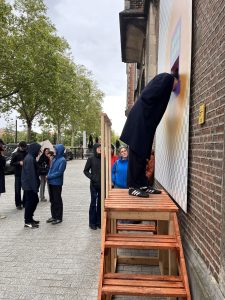
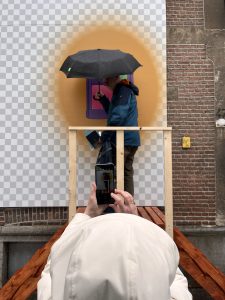
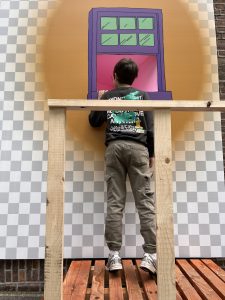
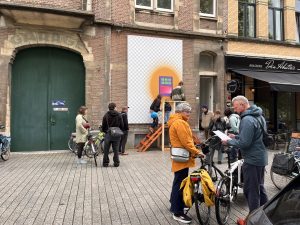
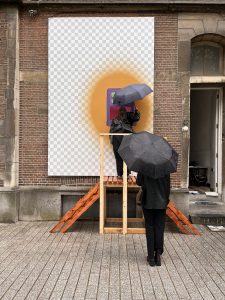
Op een bijna naïeve manier zien we een (re-)enactement van een potentieel The Simpsons-fragment. Episode 47a (47 is het huisnummer van de locatie) toont Vaast Colson in de figuur van Bart Simpson, rood T-shirt, blauw broekje en blauwe basketters, geel gezicht, …. In de 2de episode zal hij de typische kledij van Beuys dragen, maar alsof het een “guest-star” betreft in The Simpsons, ook met geel gelaat, en in het klaslokaal van Bart’s school in Springfield.
Op het bord verschijnen als een stream of consciousness de standpunten van Vaast Colson. Hij formuleert het zo: “Het bord, de lege drager, is een opportuniteit om alles wat in me opkomt eruit te gooien, te noteren. Als het bord vol is, maak ik het leeg; een camera registreert wat er op het bord gebeurt, en dat wil ik later ook bekijken. Wat ik ga doen bevindt zich in het spanninsveld tussen automatic writing en wat men vandaag de dag brain dumping noemt: Brain dumping is een techniek waarbij je al je gedachten en ideeën snel op papier schrijft om mentale ruimte te creëren en stress te verminderen. Het hoofd dat te vol zit (wat leidt tot burn out, slapeloosheid, chronische vermoeidheid, …) moet leeggemaakt worden. Er bestaan ondertussen applicaties die brain dumping fasciliteren en wat er “gedumpt wordt” economisch laten renderen. Alsof alles productief moet zijn…”. Als men de schedel als een pand opvat, wil Vaast Colson “het hoofd volledig leegmaken!”
Colson kruipt in de huid van twee protagonisten. Er wordt geen onderscheid gemaakt tussen een tekenfilmpersonage en een historische figuur. De één is een icoon uit de populaire cultuur, de andere uit de kunstgeschiedenis. Beiden verhouden zich tot het schoolbord. Dat laatste is het belangrijkste gegeven: daarop verschijnen ideeën, fragmenten, tekeningen, tekst, … Die omgeving kiest Colson als de plaats waar hij zo lang als mogelijk ononderbroken wil blijven werken, als schrijver op het bord. In de eerste sessie alvast vergelijkbaar met Bart: met de rug naar het publiek, niet als pedagoog met het bord als didactisch medium.
In de tweede sessie zal dit anders zijn.
Het bord is het kader waarbinnen de actie zich ontwikkelt; er is het kader van de camera, van het kijkgat, het tijdskader, het denkkader.
Stella Lohaus, mei ’26
ENG
Chalkboard confessions, blackboard gags, stick-slips, kickflips and other writings
Episode 47a B.S.
Episode 47b J.B.
The enigmatic title, which is composed of words drawn from various registers and jargons, reveals the connection that Vaast Colson tries to make in his artistic thinking and work: how does the artist relate to the world and to life? Where does the emphasis of the oeuvre lie in relation to events in the world, and what differences in scale and action play a role here? Formulating answers to these questions means repeatedly taking up the challenge of seeking out these reference points and directing one’s actions towards them (calibrating).
This exhibition is about points of view.
A camera sequence opens onto the sky before descending into the city, its streets and buildings, finally zooming into a classroom through an open window.
The viewer’s gaze is directed towards the blackboard.
The two different English words for ‘schoolboard’ point to a difference in perspective: ‘chalkboard’ refers to the material used (chalk) that is applied to the board, whereas ‘blackboard’ defines a characteristic (black) of the surface. Both signifiers, which refer to the same thing but are named differently, inspire Colson, who is interested in this kind of shift.
That ‘shift’ is often irritating. Colson mentions this in the next word in the title: stick-slips. This is the phenomenon whereby a jerky movement sometimes occurs spontaneously when two objects slide over one another. This jerky movement is often accompanied by creaking or scraping sounds (low frequencies) or a whining noise (higher frequencies). A well-known example of this is the squeaking of chalk on a blackboard.
The kickflip is a skateboarding trick: the rider jumps into the air with his board and slides his foot outwards, rotating the skateboard 360 degrees around its axis. The rider is then supposed to land back on the skateboard. At the bottom is the abbreviation B.S.: Bart Simpson. The cheeky little boy from Matt Groening’s series starts every opening sequence of The Simpsons with a sentence that he writes on a new line on the blackboard (as a punishment?) until the bell rings.
A week later, Vaast Colson shows the second part of the work, now signed J.B.
In 1972, Joseph Beuys (1921–1986) was invited to the Tate Gallery in London to fill a gap in the exhibition programme caused by further delays in the construction of the new wing, which finally opened in 1979. Beuys’ contribution, Information Action, took place on 26 February 1972. For six and a half hours, Beuys gave a lecture and engaged in a discussion about his connections between art, politics, personal charisma, paradoxes and utopian ideas. The entire event was recorded on video. For his presentation, he used blackboards (Schultafel), on which he summarised and visualised his ideas through words and diagrams.
The blackboard plays a central role in the teaching and learning process. Generally, it is used as a medium for text and images when the attention of a group needs to be visually gathered. In Beuys’s oeuvre, this pedagogical tool takes on an important role very early on in his Aktionen (e.g. Siberian Symphony 1963–66) and particularly when discussing his political views, his ideas on economics, and so on. It is these aspects of Beuys that intrigue Colson.
Bart Simpson writes on the blackboard as a student being punished, whereas Joseph Beuys is in the position of the teacher. He uses the blackboard as a teaching aid. Ultimately, Beuys’s blackboards are complete works of art (as is the video tape on which the lecture is recorded); they are included in museum collections (including the Tate, London, and MoMA, New York).
In an almost naive manner, we get to see a (re-)enactment of a potential Simpsons-fragment. Episode 47a (47 is the house number of the location) features Vaast Colson as the persona of Bart Simpson: red T-shirt, blue shorts and blue trainers, yellow face. In the second episode, he will wear Beuys’s typical attire, but as though he were a guest star in The Simpsons, also with a yellow face, and in the classroom of Bart’s school in Springfield.
Vaast Colson’s thoughts appear on the board in a stream of consciousness. He puts it this way: “The board, the blank canvas, is an opportunity to let everything that comes to mind pour out onto it, to write it down. When the board is full, I erase it; a camera registers what happens on the board, and I want to look at that later as well. What I’m going to do lies somewhere between automatic writing and what is nowadays called brain dumping: Brain dumping is a technique where you quickly write down all your thoughts and ideas on paper to create mental space and reduce stress. A mind that is too full (leading to burnout, insomnia, chronic fatigue, etc.) needs to be emptied. There are now apps that facilitate brain dumping and make what is ‘dumped’ economically exploitable. As if everything must be productive…”. If one regards the skull as a building, Vaast Colson wants to “completely empty the head!”
Colson takes on the roles of two protagonists. No distinction is made between a cartoon character and a historical figure. One is an icon of popular culture, the other of art history. Both relate to the blackboard. The latter is the most important element: that is where ideas, fragments, drawings, text, and so on appear. Colson chooses this environment as the place where he wishes to work continuously for as long as possible, as a writer on the blackboard. In the first session, he is much like Bart: facing away from the audience, not as a teacher using the blackboard as a didactic medium.
In the second session, this will be different.
The blackboard is the framework within which the action develops; there is the frame of the camera, of the peephole, the time frame, the conceptual framework.
Stella Lohaus, May ’26


Met dank aan Dorian Baetens, Gerard Herman, Kris Van Dessel, Ken Verhoeven.
LLS Paleis wordt gesteund door de Vlaamse overheid en gesponsord door Duvel Moortgat en Ghysel en De Lombaerde accountancy & fiscaliteit.